





Equity Capital Markets
Brief History of Bursa Malaysia
Bursa Malaysia Berhad is an exchange holding company previously known as Kuala Lumpur Stock Exchange (“KLSE“). On 14 April 2004, KLSE was renamed Bursa Mfalaysia Berhad following its demutualisation exercise.
On 18 March 2005, Bursa Malaysia Berhad was listed on the Main Board of its subsidiary, Bursa Malaysia Securities Berhad (“Bursa Securities“), which operates a fully-integrated exchange, offering a comprehensive range of exchange-related facilities including listing, trading, clearing, settlement and depository services. Bursa Securities is a single consolidated group comprising equities, derivatives and offshore markets.
Bursa Securities currently operates 3 listing platforms: Main Market, ACE (Access, Certainty, Efficiency) Market and LEAP (Leading Entrepreneur Accelerator Platform) Market. The LEAP Market aims to provide small and medium-sized enterprises (“SMEs“) with a new platform to raise funds from sophisticated investors. It addresses the funding gap faced by SMEs and the over-dependency of SMEs on financial institutions.
According to the Annual Report 2025 by Bursa Malaysia Berhad, securities market capitalisation rose to MYR 2.1 trillion, with over 1,081 entities listed on Bursa Securities, consisting of 792 companies on the Main Market, 241 companies on the ACE Market and 48 companies on the LEAP Market.
The Labuan International Financial Exchange (“LFX“) is an international financial exchange based in Labuan and is wholly owned by Bursa Malaysia Berhad. LFX was established to complement the various business and financial services available in Labuan. LFX is a one-stop financial exchange offering full services from the submission of application to approval, listing, trading and settlement of the instruments.
Primary Listing for Malaysian Companies
Main market
The Main Market is the prime market for established companies that have met the standards in terms of quality, size and operations. Companies seeking listing on the Main Market must demonstrate that they have achieved the minimum profit track record or minimum size as measured by market capitalisation or have the right to build and operate an infrastructure project with the required minimum project costs and remaining concession or licence period.
Ace Market
ACE Market is a sponsor-driven market designed for companies with growth prospects. Sponsors must assess the suitability of the potential issuers, taking into consideration attributes such as business prospects, corporate conduct and adequacy of internal control.
LEAP Market
LEAP Market is an adviser-driven market which aims to provide emerging companies (including small- and medium-sized enterprises) with greater fundraising access and viability via the capital market. LEAP Market is accessible only to sophisticated investors as prescribed under the Capital Markets and Services Act 2007 (“CMSA“).
Quantitative Listing Requirements
The tables below summarise the key listing criteria on the Main Market, ACE Market and LEAP Market respectively.
Aspect | Main Market | ACE Market | LEAP Market | |||||||||
Quantitative criteria | The issuer should satisfy one of the following tests for listing: Profit test
Market capitalisation test
Infrastructure project corporation test
| No minimum operating track record or profit requirement. | No minimum operating track record or profit requirement. | |||||||||
Financial position and liquidity | The issuer must have a healthy financial position, with–
When assessing the issuer’s healthy financial position, the SC will take into account whether the issuer has positive cash flow from operating activities over the most recent three full financial years, or since the commencement of its operations, if less than three full financial years, based on the audited financial statements. The reporting accountants must not have expressed a modified opinion[1] and there is no statement of material uncertainty related to going concern on the audited financial statements of the issuer contained in the accountants’ report. | Sufficient level of working capital for at least 12 months from the date of the prospectus. | Not applicable. | |||||||||
Public[2] Shareholding Spread | At least 25% of the total listed shares has to be in the hands of a minimum number of 1,000 public shareholders holding not less than 100 shares each at the point of admission and post-listing. | At least 25% of the total listed shares has to be in the hands of a minimum of 200 public shareholders holding not less than 100 shares each at the point of admission and post-listing. | At least 10% of the total listed shares has to be in the hands of public shareholders at the point of admission. | |||||||||
With effect from March 2021 Bursa Securities may, on the application by the issuer, accept a percentage lower than the 25% threshold if all the conditions below are met:
| Not applicable. | |||||||||||
Approval | The listing has to be approved by both the SC and Bursa Securities. | Only the approval of Bursa Securities is necessary. | Only the approval of Bursa Securities is necessary. | |||||||||
Bumiputera[3] Equity Requirement
| Allocation of 12.5% of the issuer’s enlarged share capital to Bumiputera investors to be approved or recognised by Ministry of Investment, Trade and Industry (“MITI“) at the point of admission. In addition, allocation of at least 50% of the shares offered to the Malaysian public investors via balloting must be made available to Bumiputera public investors. Exemptions – Corporations undertaking one of the following corporate proposals will be exempted from complying with the Bumiputera Equity Requirement:
Although the above corporations are exempted from complying with the Bumiputera Equity Requirement, the corporations are required to notify the SC of the corporate proposal and the basis of exemption from complying with the Bumiputera Equity Requirement. Notwithstanding, if the corporations offer shares to the Malaysian public investors via balloting in conjunction with the corporate proposal, at least 50% must be made available to Bumiputera public investors at the point of implementation. Should the corporations undertake subsequent corporate proposals involving transfer of their listing status from the ACE Market to the Main Market of Bursa Malaysia or acquisition which results in a significant change in the business direction or policy of the listed corporation, the corporations must submit such applications to the SC for a re-assessment. The SC will re-assess whether such corporations are still exempted from complying with the Bumiputera Equity Requirement. |
| No such requirement at the point of admission. | |||||||||
[1] “Modified opinion” means an adverse opinion, a qualified opinion, or a disclaimer of opinion, as defined in the Equity Guidelines revised on 28 May 2026.
[2] “Public” refers to persons other than directors, substantial shareholders, or controlling shareholders of the issuer and its subsidiaries and their respective associates, as defined in the Main Market LR and the ACE Market LR.
[3] “Bumiputera” refers to Malays and natives of any of the States of Sabah and Sarawak
Other Key Admission Requirements
Aspect | Main Market | ACE Market | LEAP Market |
Initial Public Offering (“IPO”) document |
|
|
|
Sponsor requirement |
|
|
|
Restriction on specified shareholders’[5] / promoters’[6] making an offer for sale of shares | There are no restrictions on the specified shareholders making offer for sale of their own shares at the time of the IPO. | At the time of the IPO, specified shareholders are only allowed to offer their shares for sale if:
| At the time of the IPO, promoters are only allowed to offer their shares for sale if:
|
Moratorium |
|
|
|
Minimum issue price | MYR 0.50 per share | None | None |
[1] “Principal adviser” has the meaning as assigned to ‘recognised principal adviser (RPA)’ in the SC’s Licensing Handbook
[2] “Sponsor” means such persons who are registered on the Register of Sponsors
[3] “Approved Adviser” means an adviser authorised by Bursa Securities to carry out both the initial listing activities and post-listing activities
[4] “Official List” means a list specifying all securities which have been admitted for listing on the ACE Market and not removed.
[5] “Specified shareholders” of an issuer, defined pursuant to the Main Market LR and ACE Market LR, means a controlling shareholder, a person connected to a controlling shareholder, and an executive director who is a substantial shareholder, of the applicant or listed corporation, or any other person as specified by Bursa Securities.
[6] “Promoter” is a party to the preparation of the prospectus or any relevant portion thereof, but does not include any person by reason only of his acting in a professional capacity.
Listing Timeline
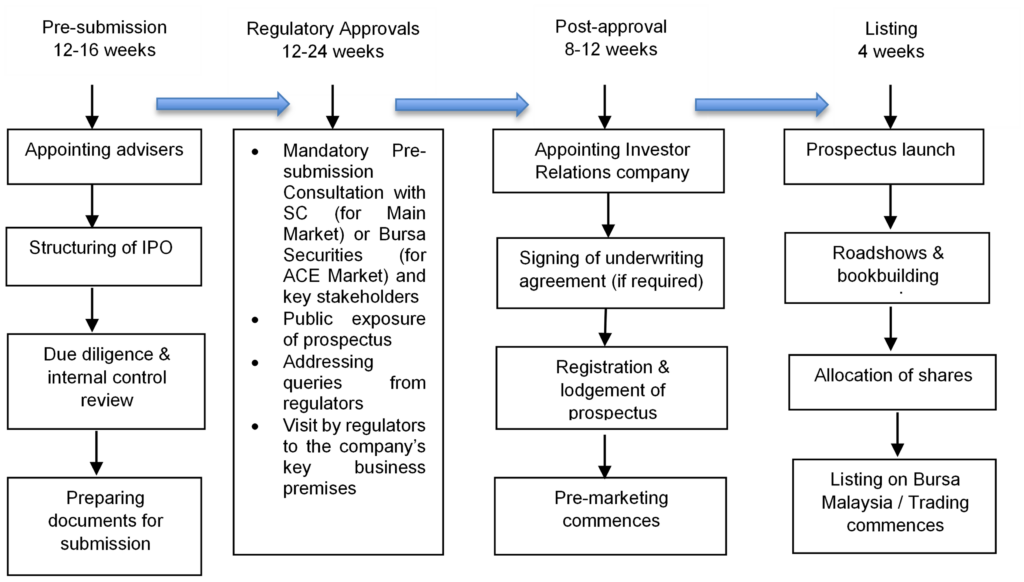
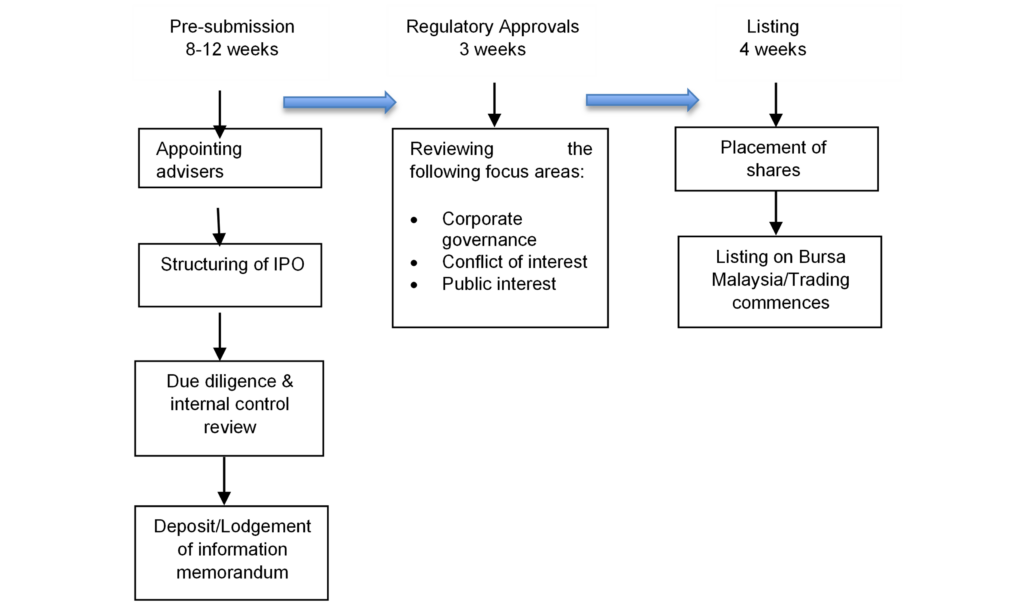
The listing process (from the time the issuer engages an adviser to the day of listing) will normally take 6 to 12 months, depending on whether it is Main Market, ACE Market or LEAP Market as well as the structure and complexity of the listing scheme. Upon approval, the issuer will be given 6 months to complete the IPO exercise. The conceptual timeline for the listing process is as follows:
Listing Process for the Main Market and ACE Market[10]
Listing Process for LEAP Market[11]
Regulatory Framework
Regulatory Bodies
The SC is the main regulator in respect of securities laws in Malaysia. It was established in 1993 by way of an act of Parliament, namely the Securities Commission Act 1993, which was later renamed the Securities Commission Malaysia Act 1993 in 2015. It has a broad range of regulatory functions, including rulemaking, gatekeeping, surveillance, supervision, complaints handling and enforcement, in order to promote and maintain fair, efficient, secure and transparent capital markets in Malaysia.
Bursa Malaysia is an exchange holding company established in 1976 and listed in 2005. It operates and regulates a fully integrated exchange, offering a comprehensive range of investment and trading products, including equities, derivatives, offshore and Islamic assets, Exchange Traded Funds, Real Estate Investment Trusts, Exchange Traded Bonds and Sukuk, Business Trusts and Investment Notes as well as a complete spectrum of exchange-related services such as listing, trading, clearing, settlement and depository.
Legislations and Regulations
Economic Profile
Malaysia is considered one of the most developed economies in South East Asia, with its GDP per capita at the national level rising to RM54,612 in 2023. Five states surpassed the national level, led by W.P. Kuala Lumpur (RM131,038), followed by W.P. Labuan (RM83,596), Pulau Pinang (RM72,586), Sarawak (RM72,411), and Selangor (RM62,492). The growth in these states was primarily driven by the services, manufacturing and construction sectors. Malaysia as an economy has progressed from being dependent on agriculture and primary commodities to being manufacturing based, and now is transforming into a diversified service and knowledge driven economy.
All of Malaysia’s development plans are prepared by the Economic Planning Unit, and development planning in Malaysia canvases short to long term plans, all of which aim to set a comprehensive strategy to achieve the targets under the national development agenda, which has pivoted from achieving high income status by the year 2020 (Vision 2020) to economic restructuring and more equitable distribution of wealth through the MADANI Economy Framework.
This policy shift comes hot on the heels of the closely watched and highly-anticipated 15th General Election on 19 November 2022 (“GE15”), which led to the formation of the present Unity Government. As part of the MADANI Economy Framework, the Unity Government has since announced and implemented a series of policies, including the National Energy Transition Roadmap, the New Industrial Masterplan 2030, and the Mid-Term Review of the 12th Malaysia Plan.
High-impact socioeconomic development projects, such as the Johor-Singapore Rapid Transit System Link, Klang Valley MRT3, and the Penang LRT, have also been continued under the Unity Government to elevate the wellbeing of the Malaysian population, particularly those residing outside the Klang Valley. Further, the existing development gaps between states will be narrowed by giving greater emphasis to less developed states, particularly Sabah, Sarawak, Kelantan, Terengganu, Kedah and Perlis, to ensure more balanced regional growth. More measures will also be undertaken to raise the income and purchasing power of the local population, especially the bottom 40% of the household income group (B40).
Economic Activities
In terms of magnitude of the various economic activities, the service sector is the largest contributor to the GDP of Malaysia. Major subsectors within services include finance and insurance, real estate, and business services; wholesale and retail trade; transport and communication. The government plans to develop the services sector through the Services Sector Blueprint as well as efforts in promoting Digital Free Trade Zone and productivity improvements under the Malaysia Productivity Blueprint. Additionally, there has also been greater emphasis on establishing economic zones/corridors, such as the Johor-Singapore Special Economic Zone.
Aside from services, the manufacturing sector is the second largest contributor to the GDP of Malaysia, and other major contributors include construction, mining and quarrying.
Malaysia's HDP Growth by Sector
The cornerstone of the legal and regulatory framework governing the Malaysian capital markets is the CMSA, which consolidates the Securities Industry Act 1983 and Futures Industry Act 1993, and came into force on 28 September 2007. The CMSA aims to regulate and to provide for matters relating to the activities, markets and intermediaries in the capital markets by setting out the law relating to the regulations of markets, the licensing and conduct of intermediaries, the regulation of market misconduct, fundraising and takeovers.
Listings on Bursa Securities are regulated under the CMSA, together with various equity-related guidelines issued by the SC including the following, inter alia:
- Equity Guidelines (which are not applicable for exercises on the ACE Market and the LEAP Market);
- Prospectus Guidelines;
- Guidelines on Submission of Corporate and Capital Market Product Proposals;
- Guidelines on Listed Real Estate Investment Trust; and
- Business Trust Guidelines.
As a self-regulated organisation under the CMSA, Bursa Securities has also issued its Listing Requirements for the Main Market (“Main Market LR“), ACE Market (“ACE Market LR“) and LEAP Market (“LEAP Market LR“) respectively to regulate the capital market conducts of the listed companies.
Enforcement
Under the regulatory framework of the capital markets in Malaysia, the SC may take enforcement actions against market participants who behave irresponsibly, negligently or in breach of the laws, including claims and actions ranging from criminal prosecution, civil actions and regulatory settlements, compounding cases to administrative actions. Under the CMSA, the common market misconducts or prohibited conducts observed in the capital markets include, inter alia:
- making false or misleading statements in a disclosure document or prospectus[1];
- submitting false or misleading statements to the SC or Bursa Securities[2];
- insider trading[3];
- causing wrongful loss to the listed corporation or any of its related corporations[4]; and
- other prohibited conducts that are subject to legal consequences under Sections 182 and 200 of the CMSA, inter alia, false trading[5], market rigging transactions[6]and stock market manipulation[7], fraudulently inducing persons to deal in securities[8], use of manipulative and deceptive devices[9] and dissemination of information about illegal transactions[10].
[1] Section 177 of the CMSA
[2] Section 369 of the CMSA
[3] Section 188 of the CMSA
[4] Section 317A of the CMSA
[5] Section 175 of the CMSA
[6] Ibid
[7] Section 176 of the CMSA
[8] Section 178 of the CMSA
[9] Section 179 of the CMSA
[10] Section 181 of the CMSA
Other types of listings on Bursa Securities
Primary listing of foreign corporations on Main Market or ACE Market
In addition to the key listing criteria as that for local companies, a foreign corporation seeking primary listing on Bursa Securities (“Foreign Applicant“) is also subject to the following additional criteria:
Aspect | Main Market & ACE Market |
Place of incorporation |
|
Approval of regulatory authorities of foreign jurisdiction | Must obtain the approval of all relevant regulatory authorities of the jurisdiction in which it is incorporated and carries out its core business, as may be required, before issuing its prospectus. |
Registration | Must be registered as a foreign company under the Companies Act 2016. |
Accounting standards | The accounting standards applied are in accordance with the Financial Reporting Act 1997, which include International Accounting Standards. |
Auditing standards | The auditing standards applied are in accordance with the approved auditing standards applied in Malaysia or International Standards in Auditing. |
Audit committee | The audit committee must consist of at least one independent director who has a principal or only place of residence in Malaysia. |
Translation of documents | All documents to be submitted to the authorities (including financial statements), which are in a language other than English, must be accompanied by a certified English translation. |
Valuation of assets | Standards for valuation of assets shall be that applied in Malaysia or in accordance with International Valuation Standards. |
Currency denomination | Required to consult Bursa Securities and obtain approval of Bank Negara Malaysia for quotation of securities in a foreign currency. |
Approval of Bank Negara Malaysia | Must, where applicable, obtain the prior approval of Bank Negara Malaysia for the utilisation of proceeds from the offering of securities. |
Resident directors | Predominantly Malaysian-based operations must have a majority of directors whose principal or only place of residence is in Malaysia. On the other hand, predominantly foreign-based operations must have at least two independent directors whose principal or only place of residence is in Malaysia and at least one of these directors must be a member of the company’s audit committee. |
Agent or representative | An agent or representative in Malaysia be appointed to be responsible for communication with the Exchange, on behalf of the Foreign Applicant. |
Secondary listing of foreign corporations on Main Market
A foreign corporation seeking secondary listing on Bursa Securities (“Foreign Applicant in Secondary Listing“) must fulfil the following criteria prior to its secondary listing on Bursa Securities:
Aspect | Main Market |
Listing board | Secondary listing is allowed on Main Market only. |
Additional listing criteria | In addition to complying with all the criteria for primary listing of foreign corporations, a Foreign Applicant in Secondary Listing must comply with the following:
|
Approvals | Must first obtain approval(s) from the SC and other relevant authorities (where applicable) before listing and quotation of any security will be considered by Bursa Securities. |
Business trust ("BT")
BT is a unit trust scheme by which underlying assets constitute an on-going business. Essentially a BT is a trust that functions through a trustee-manager to own and operate a business for the benefit of unit holders. The trustee-manager is required to manage the fund in a prudent manner and will be accountable to the unit holders, failing which it could be removed as the trustee-manager. A BT structure offers greater flexibility when compared with a company incorporated in Malaysia since a BT is able to make distributions to its investors from its operating cash flow, subject to solvency requirements, while a Malaysia-incorporated company can only make distributions out of profits.
A BT’s total market capitalisation must be at least MYR 1 billion based on issue or offer price in order to obtain a primary listing on the Main Market of Bursa Securities. Where the listing of a BT is sought based on strength of the BT group of companies, the BT and its subsidiary entities must have common controlling unit holders or controlling shareholders of at least one full financial year prior to submission to the SC. Further, for purposes of listing, the core business underlying the BT must have been in operation and generating operating revenue for at least one full financial year prior to submission to the SC. A foreign BT established outside Malaysia could be recognised under CMSA for application of listing on Bursa Securities. Units in BTs listed on Bursa Securities can be traded like equity stocks.
Real Estate Investment Trust ("REIT")
REIT is a fund or trust with the underlying assets of income-producing commercial real estate such as shopping complexes, industrial properties, hotels and office blocks, being managed by a management company. The management company for a REIT is allowed to deduct distribution paid to its unit holders directly from its corporate taxable income. In order to enjoy this tax-free status in distribution of profits to unit holders, the REIT is required to have most of its assets and income to be tied to real estate and distribute at least 90% of its total income to unit holders annually. Units in REITs listed on Bursa Securities can be traded like equity stocks.
Special Purpose Acquisition Company ("SPAC")
A SPAC is a company that is initially listed on stock market without existing business operations but formed exclusively to make acquisitions using proceeds raised from its listing on stock market. Funds are raised by SPACs based primarily on the prior track record of the individuals forming the management team who promote the investment venture, with a minimum fund size to be raised of MYR 100 million. Notwithstanding this minimum requirement, a SPAC must demonstrate that the gross proceeds to be raised from the initial public offering would be sufficient to undertake a qualifying acquisition.
Post-Listing Equity Fundraising Exercise
Rights Issue
A rights issue is a method for a listed company to raise additional capital by making an offer to the existing shareholders to purchase shares or other convertible securities (such as warrants and loan stocks) on a pro rata basis. In Malaysia, a listed company must ensure that a rights issue allows for renunciation in part of or in whole in favour of a third party at the option of the entitled security holders. A rights issue exercise must comply with disclosure requirements under the Listing Requirements of Bursa Securities and relevant announcements must be made and subsequently the rights issue is subject to, among others, the approval of Bursa Securities for the listing and quotation of the rights shares and the approval of the shareholders in a general meeting. A rights issue will require the issuance of an abridged prospectus to shareholders. The listed company may enter into underwriting arrangements with underwriters to cover any portion of the rights issue which are not subscribed for by the shareholders. It is also common for shareholders (typically the controlling/major shareholders) to provide an irrevocable undertaking to subscribe for their entitlements and/or any excess shares.
Private Placement
A private placement is another fundraising option which can be undertaken by a listed company through the issuance of new securities to a selective group of investors (which are typically institutional or sophisticated/high net worth investors). Unlike a rights issue exercise, a private placement does not require the issuance of a prospectus, although it must comply with disclosure requirements under the Listing Requirements of Bursa Securities and relevant announcements must be made. If a general mandate has been obtained by the listed company during its general meeting, a private placement will not require a fresh shareholder approval so long as the number of new shares or convertible securities to be issued (when aggregated with the total number of shares and convertible securities issued in the preceding 12 months), does not exceed 10% of the total number of issued shares (excluding treasury shares) of the listed company. Where the private placement involves an issue of shares or other convertible securities that departs from any of the applicable requirements stipulated in the Listing Requirements of Bursa Securities, the listed company must obtain the prior shareholder approval in a general meeting for the precise terms and conditions of the issue. The listing and quotation of the placement shares are also subject to the approval of Bursa Securities. While a private placement exercise is typically quicker and more cost-effective compared to other fundraising exercises, it will cause shareholding dilution to existing shareholders, as the new shares are issued to third party investors.
Bodies, Groups and Initiatives
Minority Shareholders' Watch Group ("MSWG")
The MSWG was set up in August 2000 as a non-profit government initiative to spearhead shareholder activism, particularly to protect the interests of retail and minority shareholders in Malaysia. The objective of the MSWG is to encourage good corporate governance amongst public listed companies, to preserve and advocate shareholder rights, to minimise risks to shareholders, and ultimately to enhance value of the shareholders and the capital market over time. As a self-governing, non-profit organisation, MSWG is substantially funded by the Capital Market Development Fund (CMDF).
The objectives of MSWG include, among others:
- To become the Forum on minority shareholders’ experiences.
- To become a thought leader for minority interest and corporate governance matters in Malaysia.
- To develop and disseminate the educational aspects of corporate governance, and to develop the competencies of minority shareholders towards informed investment decision-making.
- To become the platform to initiate collective shareholder activism on questionable practices by management of public listed companies.
To date, the MSWG has been successful in building up their credibility by their active participation in AGMs and EGMs, where the MSWG highlight concerns and issues relevant to retail and minority shareholders, by scrutinising financial, operational and governance matters. Further, the MSWG carried out the MSWG Strategic Roadmap 2022-2024, which laid foundation for a structured approach to corporate monitoring and governance reform. With its completion, the MSWG moves forward with Vision 28, a strategy designed to elevate corporate governance standards and market transparency by leveraging on data analytics and deeper stakeholder engagement to drive effective governance oversight.
Capital Markets Malaysia
The Capital Markets Promotion Council was established in 2012 as part of the efforts by the Malaysian Government and the SC to promote the country’s value proposition across various segments of the capital market both in the domestic and international arena. In 2014, SC rebranded the Council as Capital Markets Malaysia (CMM). CMM engages with a diverse pool of international and domestic capital stakeholders to spearhead the local and international positioning as well as profiling of the capital markets in Malaysia. It is funded by the Capital Markets Development Fund.
Expanding Investment Avenues
Developmental efforts by the SC also focused on enhancing the capital market’s capacity by expanding access to capital market financing for smaller and innovative businesses while also facilitating sustainable and socially responsible investments.
In September 2023, the SC has signed a Memorandum of Understanding (MoU) with SME Corporation Malaysia (SME Corp. Malaysia) to facilitate greater access to capital market financing for micro-SMEs (MSMEs). The three-year MoU paves the way for cooperation in building a strong pipeline of capital market-ready MSMEs.
In February 2025, the MITI and the SC have jointly launched the Strategic Co-Investment Fund (CoSIF) under the New Industrial Master Plan 2030. With an initial allocation of MYR 131.5 million, CoSIF will be distributed through Equity Crowdfunding and Peer-to-Peer Financing (P2P) platforms to support the growth of local SMEs and mid-tier companies in strategic sectors.
The Capital Market Masterplan 2026-2030, launched in March 2026, is built upon four core themes: vibrancy, inclusivity, sustainability and regional opportunities. The focus includes broadening participation of Malaysians and enterprises in the capital market, stronger financial literacy, and expanding fundraising channel for SMEs and mid-tier companies. The plan further targets MYR 90 billion to MYR 100 billion in cumulative financing by 2030 for climate mitigation, adaptation, resilience and broader social outcomes.
Recent Key Developments
The SC continues to review its existing framework and regulations in light of recent developments taking place globally. In a bid to strengthen the positioning of key market segments as well as enhancing the attractiveness of the Malaysian capital market, the SC has initiated the following key developments:
- Introduction of Guidelines on Digital Assets;
- Streamlining of market transfers and listing process;
- Introduction of Sophisticated Investor Guidelines;
- Introduction of the Practical Guide on Venture Capital and Private Equity;
- Establishment of the Single Family Office scheme;
- Introduction of Regulatory Sandbox;
- Revision of Guidelines on Advertising for Capital Market Products and Related Services;
- Introduction of Guidelines on Offer of Shares by Unlisted Public Companies;
- Introduction of Guidelines on Product Governance;
- Issuance of the Practice Note on broking services for digital assets;
- Revision of Guidelines on Recognised Markets for Digital Asset Exchange; and
- Revision of Equity Guidelines.
Below are brief details of each item above:
Guidelines on Digital Assets
The Guidelines on Digital Assets (“Digital Assets Guidelines“), which takes effect on 28 October 2020, contains a framework to enable companies to raise funds via the issuance of digital tokens in Malaysia through an Initial Exchange Offering (“IEO“) platform registered with the SC. The IEO platform is required to carry out the necessary assessment and due diligence to, among others, verify the business of the issuer and the fit and properness of the issuer’s board, as well as understand the features of the digital tokens. Prospective issuers must also satisfy governance and capital requirements.
An issuer may raise funds up to a ceiling of MYR 100 million and tap on investments from retail, sophisticated as well as angel investors, subject to the investment limits provided by the Digital Assets Guidelines. The Digital Assets Guidelines also includes rules and regulations on Digital Asset Custodians (“DAC“) to facilitate interested parties who wish to provide custody services for digital assets. The SC recognises their importance within the digital asset ecosystem of the Malaysian capital market to safeguard digital assets of investors.
SC Streamlines Market Transfers and Listing Process
The Guidelines on Digital Assets (“Digital Assets Guidelines“), which takes effect on 28 October 2020, contains a framework to enable companies to raise funds via the issuance of digital tokens in Malaysia through an Initial Exchange Offering (“IEO“) platform registered with the SC. The IEO platform is required to carry out the necessary assessment and due diligence to, among others, verify the business of the issuer and the fit and properness of the issuer’s board, as well as understand the features of the digital tokens. Prospective issuers must also satisfy governance and capital requirements.
An issuer may raise funds up to a ceiling of MYR 100 million and tap on investments from retail, sophisticated as well as angel investors, subject to the investment limits provided by the Digital Assets Guidelines. The Digital Assets Guidelines also includes rules and regulations on Digital Asset Custodians (“DAC“) to facilitate interested parties who wish to provide custody services for digital assets. The SC recognises their importance within the digital asset ecosystem of the Malaysian capital market to safeguard digital assets of investors.
SC Streamlines Market Transfers and Listing Process
The SC has introduced an accelerated transfer process, effective from 1 January 2024 through amendments to the Equity Guidelines, to facilitate the transfer of eligible ACE Market listed companies to the Main Market of Bursa Securities. Under this new framework, an applicant may seek such transfer if it has a daily market capitalisation of at least MYR 1 billion for the past 6 months and meets the profit requirements of the Main Market, amongst other requirements. Pursuant to the revised Equity Guidelines effective from 3 June 2026, applicants under the accelerated transfer process must also have sufficient level of working capital for at least 12 months from the date of transfer of listing to the Main Market, positive cash flow from operating activities for the most recent three full financial years and no accumulated losses based on their latest audited financial statements.
The revisions have further provided SC with the discretion to reject proposals or revoke approved proposals if the requirements for transfer of listing are not complied with up to the date of transfer of listing to the Main Market, whether under the accelerated transfer process or otherwise. This indicates that applicants under the accelerated transfer process are also required to meet the requirements of a minimum two-year listing period on the ACE Market, unless waiver is obtained from the SC.
In addition, the revised Equity Guidelines have also enhanced the requirements for a regular (non-accelerated) transfer of listing from the ACE Market to the Main Market. An applicant seeking transfer must have been listed on the ACE Market for at least two full financial years from the date of listing, based on the audited financial statements prior to submission to the SC, and must satisfy one of the following tests:
- the profit test;
- the market capitalisation test;
- the infrastructure project corporation test; or
- transfer in conjunction with an acquisition resulting in a significant change in the business direction or policy.
The reporting auditors must not have expressed a modified opinion and there must be no statement of material uncertainty related to going concern on the audited financial statements. There must also be continuity of substantially the same management for at least the most recent three full financial years prior to submission to the SC.
The SC and Bursa Malaysia Berhad have also jointly committed to an expedited 3-month approval period for an IPO on both the Main Market and the ACE Market to enhance Bursa Securities’ attractiveness for companies seeking to list in Malaysia.
Sophisticated Investor Guidelines
The SC has issued a new Guidelines on Categories of Sophisticated Investors (“Sophisticated Investors Guidelines“), which came into effect on 5 February 2024. The Sophisticated Investors Guidelines has widened the categories of sophisticated investor, previously based on the Capital Markets and Services Act 2007, in a move to increase capital market accessibility.
Key features of the expansion include a new category that takes into account the knowledge and experience of sophisticated investors. This will benefit individuals who are able to demonstrate financial knowledge sophistication to participate in relevant market offerings. Another key change is the inclusion of an investor’s primary residence value, up to a cap of MYR 1 million, in assessing their qualification as a sophisticated investor. Contributions from a child are also included in assessing an individual’s total net joint assets. This expansion will better depict a family’s collective financial status and investment potential.
Practical Guide on Venture Capital and Private Equity in Malaysia
The SC has issued the first edition of the Practical Guide on Venture Capital and Private Equity (“Guide on VC and PE“) in June 2024 to equip prospective venture capital (“VC“) and private equity (“PE“) fund managers, service providers and investors with in-depth practical knowledge to navigate the Malaysian policy landscape governing VC and PE operations. The SC recognises VC and PE as important components of the alternative financing ecosystem in the Malaysian capital market. They play an essential role in nurturing promising startups and high growth enterprises, which are key to catalysing innovation, opportunities for local talent and contribute to the growth of the Malaysian economy.
Key contents of the Guide on VC and PE include information on local capital market regulations pertaining to the VC and PE industries, foreign exchange policy, tax matters, fund structuring considerations and other areas critical to fund operations.
Regulatory Sandbox
As a result of the rapid evolution of technology and introduction of innovative products cutting across multiple products and services which may not fully fit into existing regulatory frameworks, the SC has introduced its Regulatory Sandbox Guidelines in February 2025 to facilitate innovation in the Malaysian capital market. The eligibility criteria for the Regulatory Sandbox include but are not limited to (i) the introduction of a capital market product or service not currently available in Malaysia and does not fully fit into any of the SC’s existing frameworks and (ii) demonstration of a clear value proposition to the Malaysian capital market.
Interested applicants must participate in the pre-consultation session with the SC before submitting an application to be admitted within the Regulatory Sandbox. The SC strongly encouraged corporations developing products and solutions that add value to the capital markets in areas such as financial inclusiveness, Islamic finance, sustainability, retirement solutions and improvement of market efficiency to apply to the Regulatory Sandbox initiative.
Guidelines on Advertising for Capital Market Products and Related Services
The revised Guidelines on Advertising for Capital Market Products and Related Services (“Advertising Guidelines“), which takes effect on 1 November 2025, updates certain requirements and guidance taking into account advertising and promotional trends globally and domestically, including the growing prominence of social media and financial influencers (finfluencers) towards ensuring responsible advertising in relation to capital market products and services.
The revised Advertising Guidelines includes new requirements relating to finfluencers who are not engaged as marketing agents by an advertiser yet on their own accord undertake advertising activities for any capital market products and services. Advertisers are also required to ensure that the advertising activities conducted by their marketing agents comply with the Advertising Guidelines, failing which they will be held accountable for the conduct of their marketing agents.
Guidelines on Offer of Shares by Unlisted Public Companies
A new Guidelines on Offer of Shares by Unlisted Public Companies (“Guidelines on Offer of Shares by UPC“) has been issued as the SC aims to enhance investor protection and safeguard market integrity. The Guidelines on Offer of Shares by UPC, which takes effect on 28 March 2025, superseded the Guidelines on Offer of Shares by Unlisted Public Companies to Sophisticated Investors issued by the SC in 2021.
The Guidelines on Offer of Shares by UPC was issued in response to, among others, an increasing number of regulatory concerns including the significant number of complaints received on misconduct pertaining to fundraising activities by an unlisted public company (“UPC“) that typically offer preference shares. Other issues include misleading information disclosed in the information memorandum, with promises of unrealistic high target dividends and returns. For instance, an UPC that wishes to offer preference shares is now mandated to appoint a corporate finance adviser and to consult the SC prior to commencement of the offering. An UPC offering Shariah-compliant shares will need to appoint a Shariah adviser registered with the SC.
Guidelines on Product Governance
The SC introduced the Guidelines on Product Governance, which took effect on 2 January 2026 and aimed at strengthening investor protection as well as encouraging responsible product development in the capital market.
The guidelines: (a) requires product issuers and distributors to prioritise investors’ interests when designing and distributing unlisted capital market products, reflecting this in its controls, policies and procedures; (b) requires firms to put in place controls and procedures that improve product suitability for the intended target market and proactively identify and prevent potential harm to investors; (c) places greater emphasis on board and management’s responsibilities by holding them accountable for product design and distribution; and (d) requires collaborative relationship between the product issuers and distributors to share information in respect of the appropriateness of target market to ensure the product continues to serve its intended purpose.
Practice Note on broking services for digital assets
“Practice Note 1/2026: Offering of Broking Services for Digital Assets” was issued and took effect on 30 January 2026.
The Practice Note permits holders of capital market services licences, specifically those for dealing in securities and dealing in securities restricted to listed securities, to further offer broking services in respect of digital assets subject to compliance with additional regulatory requirements. A licence holder must also notify the SC of its intention prior to offering of such services and submit a declaration in the prescribed format. In particular, the licence holder must only source digital assets from: (a) a digital asset exchange that is registered with the SC, or (b) a digital asset trading platform outside Malaysia that is registered with or is regulated by laws of a foreign country giving effect to the Financial Action Task Force recommendations and has a risk-based anti-money laundering system that is supervised by a competent authority.
Revision of the Guidelines on Recognised Markets for Digital Asset Exchange
The SC has on 20 May 2026 enhanced the Guidelines on Recognized Markets, marking a significant step in the evolution of the regulatory framework for Digital Asset Exchanges (“DAX“).
The revised Guidelines aim to speed up product launches on regulated DAX platforms by streamlining the approval process, fortify investor protection by strengthening client asset safeguards and enhancing the governance framework, and enhance operational resilience of regulated DAX platforms by raising requirements for financial stability, shareholding and management proficiency.
In addition, DAX operators will be included as members of the Financial Markets Ombudsman Service, giving investors access to a formal dispute resolution avenue.
Revision of the Equity Guidelines
On 28 May 2026, the SC issued the revised Equity Guidelines incorporating proposals adopted following its consultation paper published on 12 November 2025 and the public response paper issued on 28 May 2026. The revised Equity Guidelines came into effect on 3 June 2026, together with consequent amendments to the Main Market Listing Requirements and ACE Market LR.
Additional notable changes under the revised Equity Guidelines include enhancements to the framework for back-door listings and transfers of listing. The definition of “significant change in the business direction or policy of a listed corporation” has been enhanced, and the exemption under paragraph 7.01A applies only where the assets acquired are not loss-making. Where the latest announced quarterly financial results are used in the computation of percentage ratios, those results must be reviewed by the listed corporation’s external auditors and the corresponding review report submitted to the SC. In relation to transfer of listing proposals, the SC’s assessment of any past records of unusual market activities or other events has been extended from up to one year to three years prior to submission to the SC, and applies to all transfer of listing proposals.
The revised Equity Guidelines also introduce a provision enabling the SC to appoint an independent expert or agency, at the cost of the applicant, if the SC considers this necessary to obtain further information. In addition, new Guidance has been issued to clarify the SC’s expectations in relation to satisfying the profit requirements, including the factors to be considered when assessing and computing the “after-tax profit”.
For more information, click here to read more Doing Business Guide.
Notice
The contents of this Guide are owned by CLO and subject to copyright protection under the laws of Malaysia and, through international treaties, in other countries. No part of this Guide may be reproduced, licensed, sold, published, transmitted, modified, adapted, publicly displayed, broadcast (including storage in any medium by electronic means whether or not transiently for any purpose) without the prior written permission of CLO.
Please note also that whilst the information in this Guide is correct to the best of our knowledge and belief at the time of writing, it is only intended to provide a general guide to the subject matter and should not be treated as a substitute for specific professional advice for any particular course of action as such information may not suit your specific business or operational requirements. It is to your advantage to seek legal advice for your specific situation.
Disclaimer
Rajah & Tann Asia is a network of member firms with local legal practices in Cambodia, Indonesia, Lao PDR, Malaysia, Myanmar, the Philippines, Singapore, Thailand and Vietnam. Our Asian network also includes our regional office in China as well as regional desks focused on Brunei, Japan and South Asia. Member firms are independently constituted and regulated in accordance with relevant local requirements.